

Digital technologies have been transforming rail infrastructure maintenance for years. The potential is especially significant when it comes to switches, which are among the most heavily stressed and safety-critical components in the network. Sensors continuously provide condition data, while analytical models consolidate this information and enable predictive maintenance approaches.
The goal is to align inspections and maintenance intervals more closely with the actual condition of the assets. This creates substantial benefits in terms of efficiency and availability.
At the same time, practical experience shows that digital technologies are only being introduced gradually into maintenance operations. One key reason lies in the way innovations are integrated into existing maintenance regulations and standards. The adoption of data-driven approaches depends not only on their technical maturity.
How Do Technical Innovations Become Part of the Rulebook?
In rail infrastructure, new technologies only reach their full impact once they are formally integrated into the regulatory framework. The foundation for this is Germany’s Railway Construction and Operating Regulations (Eisenbahn-Bau- und Betriebsordnung/EBO), whose requirements are further specified by DB InfraGO AG through detailed internal guidelines (“Richtlinien” or Ril) for operations and maintenance.
These guidelines define binding technical inspection cycles as well as the conditions for maintenance measures and require approval by the German Federal Railway Authority (Eisenbahn-Bundesamt/EBA).
For data-driven methods such as Condition-Based Maintenance (CBM) and Predictive Maintenance (PM), this means they must fit into this existing system and be officially recognized within it. The process is clearly structured and correspondingly demanding as demonstrated by a recent study from the German Center for Rail Transport Research (Deutsches Zentrum für Schienenverkehrsforschung/DZSF).
The study examines how CBM and PM can be integrated into existing rail infrastructure maintenance regulations. The goal is to align inspections and maintenance intervals more closely with the actual condition of the assets.
Overall, the findings show that diagnostic systems already provide valuable additional information that improves maintenance decisions. However, fully replacing conventional inspections is currently not possible.
Every modification to a maintenance regulation requires proof of equivalent safety, meaning evidence that the existing safety level is at least maintained. This proof includes comprehensive risk assessments based on established methods such as FMEA (Failure Mode and Effects Analysis), as well as operational testing under real-world conditions. In addition, robust and sufficiently extensive operational data is required. This reveals one of the central challenges: the data required for validation must first be collected, standardized, and analyzed during ongoing operations.
This reveals one of the central challenges: the data required for validation must first be collected, standardized, and analyzed during ongoing operations. Only on this basis can maintenance regulations evolve. As a result, the process is both complex and time-consuming.
Another challenge lies in the structure of existing regulations themselves. Many requirements are still based on qualitative assessments, particularly visual inspections. For data-driven systems that rely on clearly defined measurements and thresholds, this creates additional coordination and validation requirements. Translating such criteria into quantitative models requires precise definitions of technical requirements.
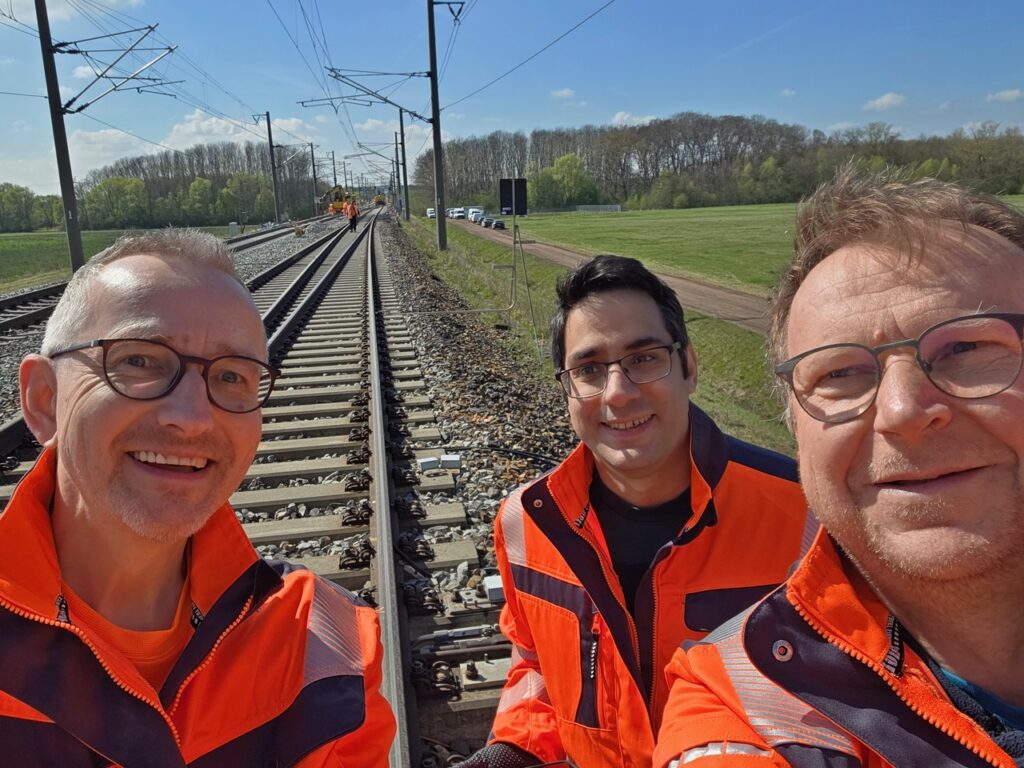
Uwe Huebler, Sven Henze, and Behrooz Bonakdar Yazdi during the installation of AXO sensors
The study on the further development of maintenance regulations identifies a clear starting point: stronger specification and quantification of requirements. Especially for optical measurement methods and the automated evaluation of maintenance measures, clearly defined quantitative requirements would make it easier to demonstrate equivalent safety when introducing new diagnostic technologies.
Diagnostic Systems in Today’s Maintenance Environment
Systems such as Continuous Track Monitoring (CTM), the DIANA switch actuator diagnostic system and ESAH-M for electronic system analysis in the frog area of switches are already in operation and continuously provide information about asset condition. The AXO sensor is also currently undergoing operational testing.
The value of these systems becomes particularly clear in switch maintenance. Actuators and moving components are highly sensitive to stress, wear, and environmental influences. Conventional inspections, however, only provide information about the condition at a specific point in time.
Sensor-based systems, by contrast, enable continuous monitoring. Changes in switching current, deviations in movement sequences, or load peaks during train passage can be detected at an early stage. This allows for a more differentiated assessment of asset condition and enables maintenance measures to be planned and carried out before operational restrictions become necessary.
In practice, this creates an important extension of existing maintenance capabilities. However, the systems do not currently allow inspections defined in maintenance regulations to be replaced or extended through diagnostic applications alone. The available data improves the quality of maintenance decisions. While CTM and DIANA provide valuable additional information and can potentially improve maintenance decisions, video monitoring could not yet be effectively evaluated due to incomplete detection capabilities and the limited adaptability of the existing FMEA methodology.
The introduction of such systems also creates organizational requirements. Data must be processed and integrated into existing workflows. In addition, clear procedures are needed for using the additional information in day-to-day operations, along with appropriate employee involvement and training.
High-Quality Data as the Basis for Further Development
As the availability of sensor data grows, a key prerequisite for the further development of maintenance emerges: reliable data environments.
In switch diagnostics, individual measurements only gain real significance when viewed in the context of historical developments. Time-series analyses make trends visible and help classify changes more accurately.
At the same time, it becomes clear that data quality, cross-system standardization, and data availability are critical. Only if data is collected consistently and analyzed in a structured way can it serve as a reliable basis for more advanced decisions and potentially for future regulatory adjustments.
How Do Other Countries Handle Regulatory Adaptation? A Look at Austria
Austria’s Federal Railways (ÖBB) also relies on data-driven maintenance but follows an approach that focuses more strongly on the direct operational use of data rather than on adapting maintenance regulations themselves.
Data is systematically collected, processed, and analyzed as time series. It directly supports maintenance teams in decisions regarding measures and priorities.
The primary focus is on making available information usable as quickly as possible. The system evolves during ongoing operations, with continuous improvement of the decision-making basis taking priority. Adjustments to maintenance regulations play a less prominent role.
According to the study, this approach leads to shorter implementation cycles in practice. New insights can be integrated directly into operations without first going through a comprehensive regulatory process. Responsibility remains with the asset manager, who makes decisions based on the available data.
Approaches for Further Development
The DZSF study outlines concrete approaches for Deutsche Bahn regarding the integration of data-driven procedures into existing maintenance regulations, using DIANA and CTM as examples.
One approach is the stronger integration of existing diagnostic data into current decision-making processes. Information from switch actuator diagnostics can be linked with operational and environmental data to support more differentiated maintenance planning. In the case of DIANA, this includes already available data such as weather conditions, switching current, switching frequency, or asset location, all of which provide additional value.
At the same time, the existing inspection system remains in place. New data-driven evaluations are introduced as complementary elements and are integrated gradually. Responsibility for adjustments also continues to rest with qualified maintenance personnel.
The proof of maintaining an equivalent level of safety follows the logic that DIANA, as an approved measurement system, provides the asset manager with all decision-relevant data on a daily basis and with the required level of accuracy, while an established evaluation model already exists for analyzing and assessing the data. In addition, the established system of deadline and interval evaluation remains in force and serves as a fallback level in the event of system failure. Responsibility for modifying intervals remains with appropriately trained asset managers.
This example highlights one of the greatest challenges in integrating new data sources into maintenance processes: the technical requirements of diagnostic applications must remain compatible with existing inspection methods.
Assessment
The framework conditions for rail network maintenance are demanding. This explains why new technologies cannot simply be rolled out overnight.
At the same time, current applications already demonstrate how much is possible today:
Particularly in switch maintenance, continuously available data provides a much clearer picture of asset condition. With every additional application, experience in handling this information grows. Integration into existing workflows is becoming increasingly routine.
Step by step, this creates greater scope for expanding data-driven approaches further. At the same time, there is still a need for optimization in order to adequately reflect these approaches within maintenance regulations and associated maintenance processes.
This includes the previously mentioned specification and quantification of technical requirements in maintenance regulations. Especially for optical measurement methods and the automated evaluation of maintenance measures, this would simplify the demonstration of equivalent safety when introducing new diagnostic technologies.
Equally important is ensuring a standardized, high-quality, and as complete as possible data foundation, as well as consistent data preparation and usage. This is essential for reliable condition monitoring, forecasting, and the timely elimination of faults.
This goes far beyond the systematic recording of faults and their causes in SAP. It also includes procedural and organizational changes as well as the implementation of a continuous change process.