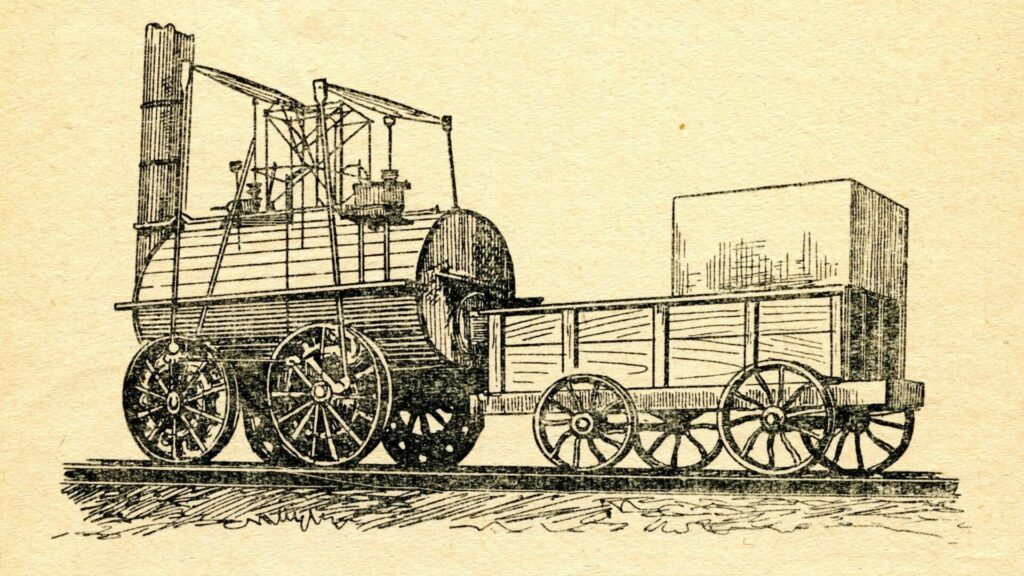

The history of railways is inseparably linked to the United Kingdom. When George Stephenson put Locomotion No. 1 into operation in 1825, launching the world’s first public steam railway, a new era of mobility began. Two hundred years later, Britain’s railway system once again stands at a turning point. With the gradual return to public ownership and a decisive push toward digitalization, it is undergoing the most profound structural and technological transformation since the Victorian era. The UK is not merely rebuilding its rail network – it is redefining the relationship between heritage, state coordination, and high-tech digital systems. What began with steam is now driven by data.
Britain’s Railways Between Historic Legacy and Modernization Pressure
September 27, 1825, marked a historic day. In Stockton in northeast England, Locomotion No. 1 set off toward Darlington and Shildon. The 38 wagons carried coal, wheat and, perhaps even more importantly, around 600 passengers. What sounds ordinary today was, at the time, the world’s first public journey on a steam railway.
Its engineer, George Stephenson, is considered a founding figure of railway engineering. His innovations revolutionized travel and enabled the safe transport of goods over long distances, significantly accelerating industrialization.
A few years later, Isambard Kingdom Brunel set new standards with the Great Western Railway (GWR). His 19th-century “high-speed line” vision included monumental structures such as the Maidenhead Railway Bridge and the two-mile-long Box Tunnel. Both are still in use today.
Yet this heritage also presents structural challenges. Many lines were designed for entirely different operating conditions. Today’s trains are heavier, run more frequently, and must meet far higher safety and reliability standards.
Moreover, Britain’s rail infrastructure was not built according to centralized standards. The result is a dense but highly complex network with restrictive loading gauges. Many tunnels and bridges are too low for modern overhead electrification systems. This poses major challenges for introducing standardized rolling stock and comprehensive electrification. Maintenance, upgrades, and operations must largely take place under live traffic conditions. Extended closures are rarely possible; complete rebuilds are seldom realistic.
The Strategic Main Corridors of the British Rail Network
Today, the British rail system is dominated by three primary corridors:
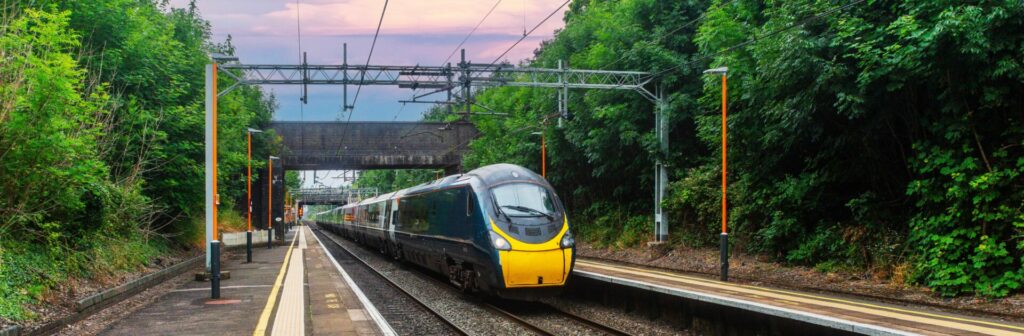
- West Coast Main Line (WCML): Running from London Euston to Glasgow via Birmingham, Manchester, and Liverpool, this is one of Europe’s most important mixed-traffic routes. Carrying around 75 million passengers annually and over 40 percent of the UK’s rail freight, it is considered the system’s “workhorse,” coordinating passenger and freight services at high frequency.
- East Coast Main Line (ECML): The historic route of the “Flying Scotsman” connects London King’s Cross with Edinburgh and is regarded as the country’s fast intercity spine. It is currently at the forefront of modernization: under the East Coast Digital Programme, the UK’s first major digitally signaled long-distance corridor is being implemented here.
- Great Western Main Line (GWML): Linking Greater London with the southwest, including Reading, Bristol, Cardiff, and extending to Penzance This corridor has been partially electrified and equipped with modern control and signaling systems in recent years.
Privatization and Fragmentation
In the 1990s, Britain’s railway was fundamentally reorganized. The government privatized large parts of the system to encourage competition and improve efficiency. Infrastructure, operations, and rolling stock were separated and assigned to different organizations.
The result was a complex structure with numerous stakeholders.
This fragmentation complicated long-term planning and coherent investment strategies. Decisions regarding maintenance, modernization, and operations required cross-organizational coordination, while demands for reliability and capacity continued to rise.
It became increasingly clear that greater integration was necessary in order to stabilise and further develop the system in the long term.
Several serious accidents further undermined public trust in the fragmented system. In particular, the Hatfield rail crash exposed structural weaknesses. Caused by a broken rail due to metal fatigue, the accident brought heavy criticism upon the private infrastructure operator Railtrack. The company was accused of insufficient technical oversight, underinvestment in maintenance, and overly complex subcontracting structures.
The ensuing safety debate accelerated political reassessment. In 2002, Railtrack was dissolved and replaced by the state-controlled Network Rail. This was a first step back toward stronger public oversight.
The Return to Public Ownership: Great British Railways
With the Passenger Railway Services (Public Ownership) Bill 2024–25, a strategic reversal is underway: the railways are gradually returning to public ownership. The creation of Great British Railways (GBR) establishes a central guiding organization that integrates infrastructure, timetable authority, and the operational framework. Acting as a “single guiding mind,” GBR will coordinate fare systems, quality standards, and investment priorities.
The transfer of private operators into public control follows a defined schedule. Major networks such as South Western Railway, c2c, Greater Anglia, and West Midlands Trains have already been brought under public responsibility. By the end of 2027, all lines controlled by the Department for Transport are expected to be integrated.
New High-Speed Corridors: Structural Policy Through New Construction
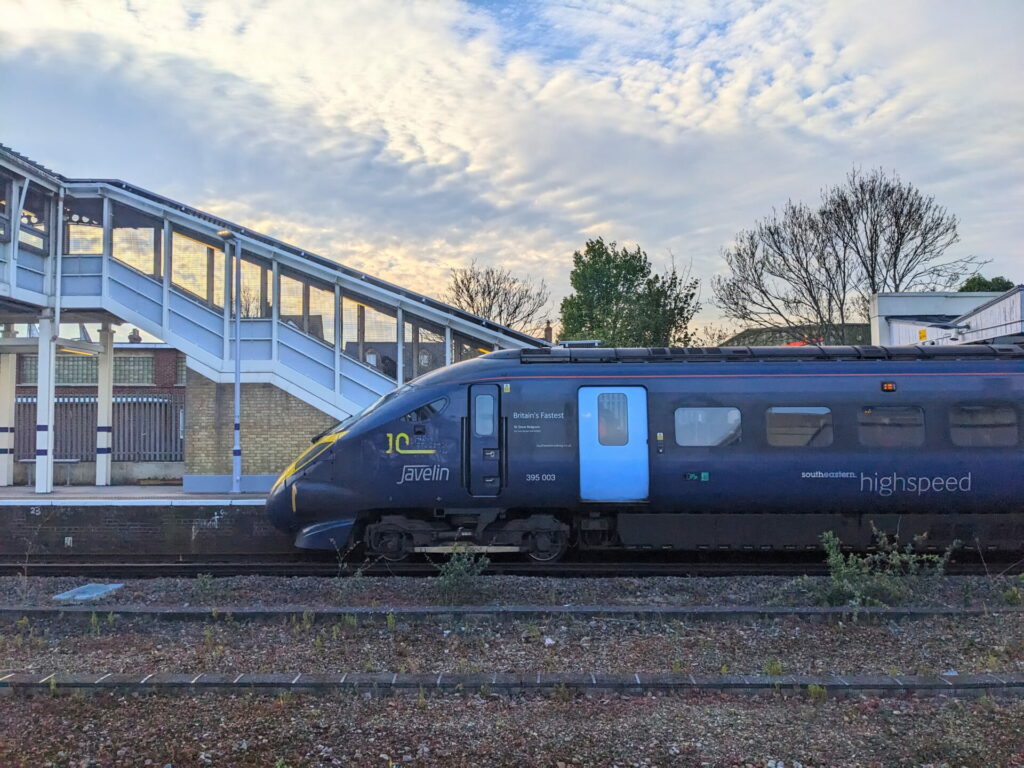
High Speed 1 (HS1), operational since 2007, is Britain’s first entirely new high-speed railway. It connects London via Kent to the Channel Tunnel and allows speeds of up to 300 km/h (186 mph). In addition to international services to Paris, Brussels, and Amsterdam, domestic “Southeastern Highspeed” trains use the route. HS1 carries around 9 to 10 million passengers annually. It has reduced travel times to cities such as Ashford and Canterbury by up to 50 percent. It is considered highly reliable and less disruption-prone than the legacy network.
Beyond linking the UK to Europe’s high-speed system, HS1 fulfills strategic goals: relieving conventional lines in southeast England and providing additional capacity for growth. It also serves as a reference project for modern high-speed infrastructure and as a knowledge base for new developments such as High Speed 2 (HS2).
High Speed 2 (HS2) is currently under construction between London and the West Midlands (Birmingham). The project is controversial. Due to planning errors and opposition from residents and environmental groups, projected costs have risen from approximately £33 billion to potentially over £80 billion, even though planned northern extensions to Manchester and Leeds have been canceled. Passenger services are not expected before 2035.
Nevertheless, HS2 remains strategically significant. Its primary objective is not to minimize travel times but to release capacity on the overloaded existing network. By shifting high-speed intercity services onto the new line, additional paths for regional and freight traffic – particularly on the WCML – will become available.
Digital Railway: Increasing Capacity Without Building New Track
Large-scale new construction in densely populated areas is expensive, time-consuming, and politically sensitive. The Digital Railway Strategy, introduced in 2019, therefore focuses on digital signaling and control technologies. The goal is to increase capacity, punctuality, and safety without building new tracks or platforms everywhere.
This strategy rests on four technical pillars:
- European Train Control System (ETCS): Transmits speed and movement authority directly into the cab, reduces headways, and gradually replaces traditional lineside signals.
- Traffic Management (TM): Optimizes timetables in real time, resolves conflicts, and limits the impact of disruptions.
- Connected Driver Advisory Systems (C-DAS): Provides drivers with real-time information on speed, stopping points, and energy efficiency.
- Intelligent Infrastructure: Sensors and data analytics monitor the condition of tracks, switches, and assets, enabling predictive maintenance.
The Long Term Deployment Plan outlines how and where ETCS and digital interlockings will be rolled out in stages, with particular focus on major corridors such as the ECML, WCML, Midland Main Line, and Great Western.
East Coast Digital Programme: ETCS in Live Operation
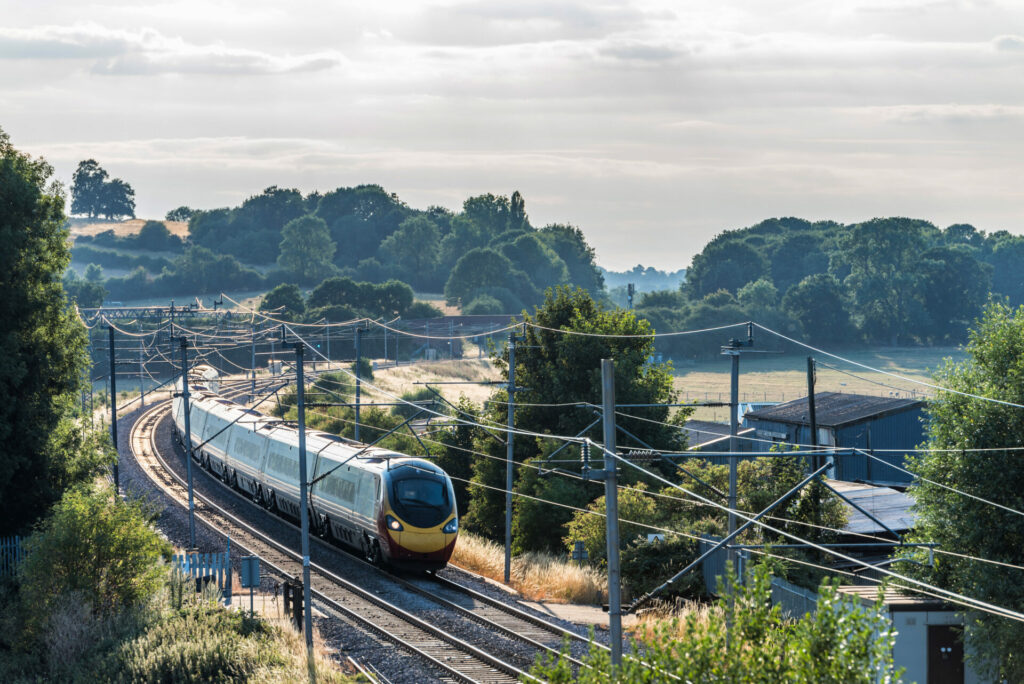
The East Coast Digital Programme (ECDP) is the first major flagship project. On the southern section of the ECML and adjacent lines, traditional lineside signaling is being replaced with in-cab digital signaling. At the same time, control centers are modernized and operational processes adapted.
On heavily used bottleneck sections, capacity increases of up to approximately 40 percent are expected. Over the lifecycle, signaling maintenance costs could decrease by 15 to 20 percent, as trackside hardware prone to wear is eliminated.
ETCS test runs are already underway on parts of the ECML and the Northern City Line. The goal is full in-cab signaling in regular service. Network Rail views the program as a reference case for digitizing high-traffic intercity corridors, including training concepts, operational rules, and rolling stock interfaces. The ambition is clear: digital signaling should become the standard, beginning with routes where conventional signaling equipment is nearing the end of its service life.
Notably, the ECDP is being implemented under full traffic conditions. The corridor remains a key artery for long-distance, commuter, and freight services throughout the transition.
Battery Trains as a Bridge Technology for Decarbonization
Despite electrification progress, parts of the British network remain without overhead wires, particularly in tunnels and under low bridges. Widening, demolishing, or rebuilding such structures would cost billions and require prolonged closures.
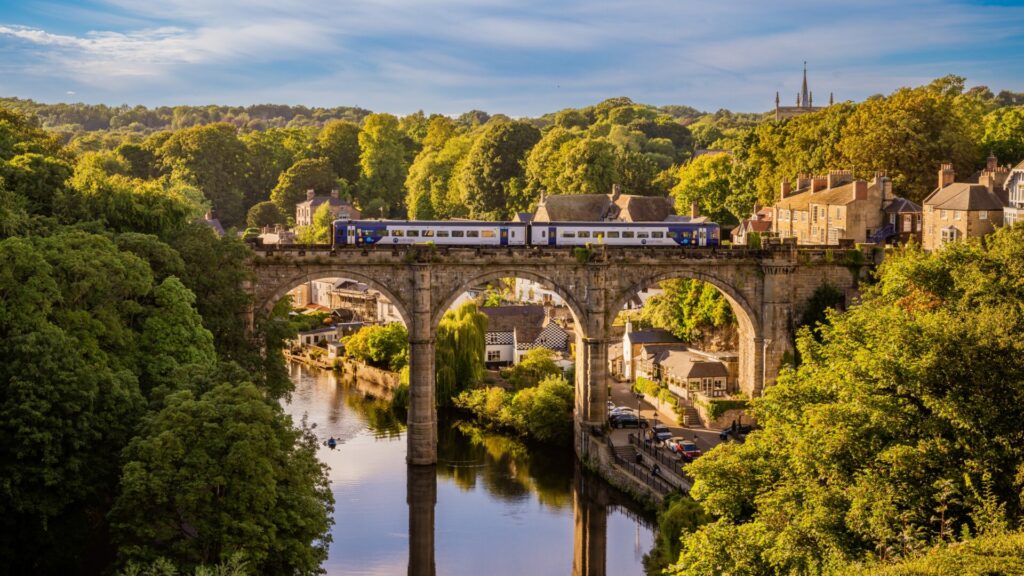
Instead, Britain increasingly relies on Battery Electric Multiple Units (BEMUs): hybrid trains that charge under existing overhead wires and bridge non-electrified sections in battery mode.
Initial projects in Scotland and Wales indicate that electrification costs can be reduced by up to around 50 percent compared to conventional overhead line projects, as expensive tunnel modifications are avoided.
This combination of overhead power and battery operation is proving a practical alternative to full electrification, balancing decarbonization, heritage preservation, and cost discipline.
Technological solutions around tunnels are increasingly complemented by data-driven infrastructure monitoring. Network Rail uses sensors, laser-based surveying, and aerial inspections to monitor cuttings and embankments continuously. LiDAR systems and drones generate high-resolution 3D data to detect ground movement early and enable preventive stabilization. Sensor-based inclinometers and real-time monitoring provide automatic alerts when slope movement is detected.
Fare Policy and Public Trust: The Social Dimension
Despite all technological advances, one question remains: how do you bring passengers along during such a profound transformation?
The UK addresses this with a combination of political signaling and financial relief. To support the transition to GBR and rebuild trust, the government plans a fare freeze in 2026. Regulated fares will be held at current levels for one year, stabilizing prices for more than one billion journeys.
At the same time, simplified fare structures, unified sales platforms, and more reliable timetables aim to make the benefits of digitalization tangible for passengers. The goal is to reposition rail clearly as the public backbone of mobility and to prioritize user interests. Digitalization only achieves its full impact when passengers experience it directly by more punctual trains, smoother connections, and transparent pricing.
Britain’s Railways: From Pioneer to Digital Trailblazer
The challenge Britain faces is shared by rail systems worldwide: how can historically evolved infrastructure be transformed into a modern, high-performance, and sustainable system?
Britain’s railway strategy offers a forward-looking answer. With the establishment of Great British Railways, comprehensive digitalization, and reintegration of operations and infrastructure, the country is pursuing a systemic transformation while at the same time returning to strategic roots.
Two hundred years after the first steam locomotive, a new chapter is beginning. But today, progress is no longer powered by steam and steel – it is driven by data and digital systems. Britain demonstrates that building an entirely new network is not the only path to modernization. By combining political realignment, digital capacity enhancement, and pragmatic hybrid technologies, the UK is transforming its historic infrastructure into a high-performance network for the 21st century.
With this step, Britain could once again assume a pioneering role – this time not as the birthplace of railways, but as a model for their digital future.
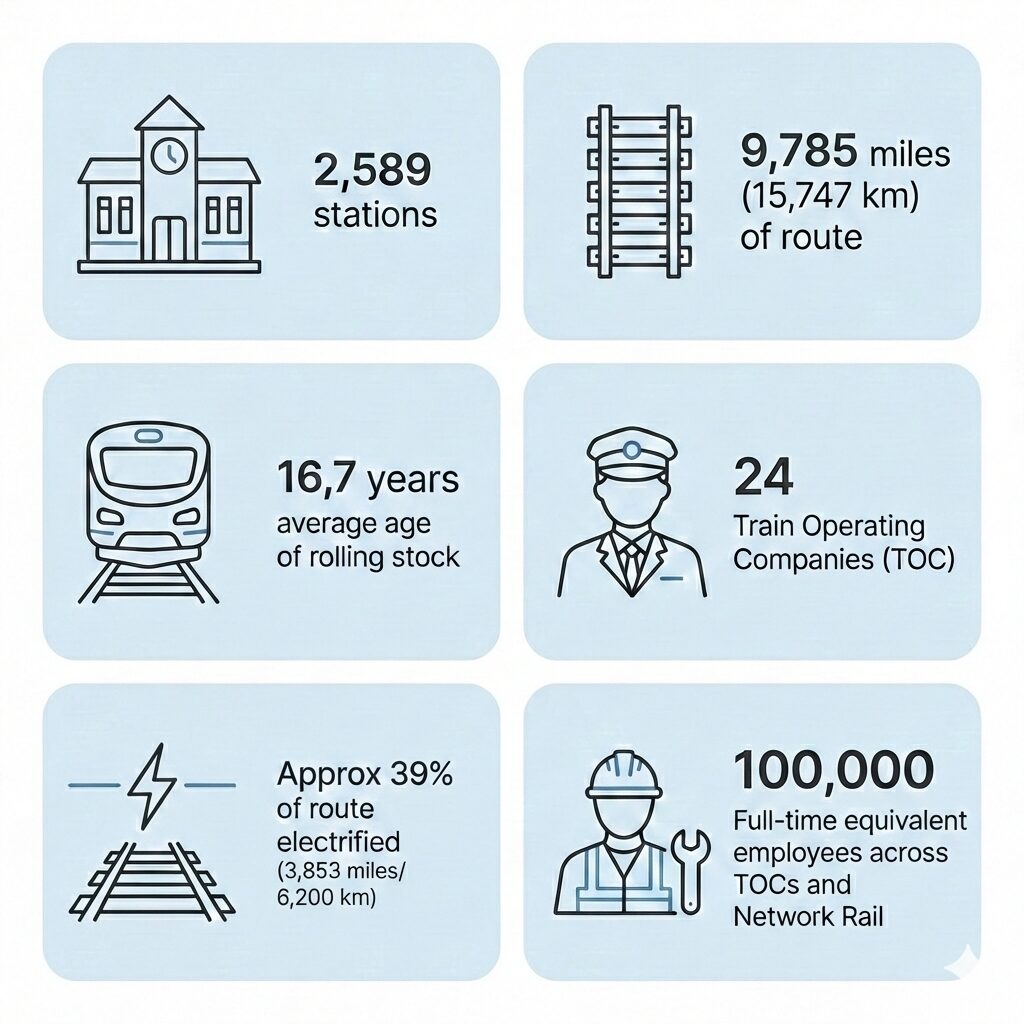
Facts and figures about Britain’s Rail (Source: Rail Trends 2025)